
There has been a sharp recovery in the headline corporate earnings in the April-June 2023 quarter (Q1FY24), after a dismal showing by early bird companies. The combined net profit of the 983 listed companies that have declared their quarterly results, so far, was up 64.7 per cent year-on-year to record a high of Rs 2.68 trillion in the first quarter, but growth in earnings remained lopsided because most of the incremental gains came from a handful of companies. Moreover, the quarterly numbers showed a continued slowdown in revenue growth.

Overall, volume growth is likely to be in the range of 3-8 per cent for two-wheelers and 5-7 per cent for passenger vehicles owing to healthy demand from urban and rural areas and pending order books.

From the Sensex pack, Adani Ports, Tata Steel, Power Grid, Mahindra & Mahindra, NTPC, Tech Mahindra, Tata Motors, ITC, Nestle India, HCL Technologies, Bharti Airtel, State Bank of India, Asian Paints and Kotak Mahindra Bank were the gainers. Bajaj Finance, IndusInd Bank, HDFC Bank, and Zomato were the laggards.

Equity benchmarks shrugged off lacklustre global cues to clock smart gains on Tuesday, buoyed by strong buying interest in index heavyweights Reliance Industries and HDFC twins. However, a depreciating rupee and unabated foreign fund outflows capped the gains, traders said. The 30-share BSE Sensex rallied 562.75 points or 0.94 per cent to settle at 60,655.72.

Ask rediffGURU and PF and MF expert Janak Patel your mutual fund and personal finance-related questions.

Bajaj Finance, Bajaj Finserv, NTPC, State Bank of India, Power Grid, HDFC Bank, Tech Mahindra and Asian Paints were the other gainers. However, Zomato, Adani Ports, Tata Consultancy Services, Mahindra & Mahindra, Maruti and Tata Motors were among the laggards.


'He has been one of the clearest thinkers in the history of business.'

All Sensex shares, except for Hindustan Unilever, ended with losses. Tata Steel fell the most by 7.33 per cent followed by Larsen & Toubro which cracked 5.78 per cent. Tata Motors, Kotak Mahindra Bank, Mahindra & Mahindra, Infosys, Axis Bank, ICICI Bank, HCL Technologies and HDFC Bank were the other big laggards. Hindustan Unilever ended marginally higher.

'We are working with a few housing finance companies to drive affordable lending because that's where we believe our sweet spot is.'

'Margins will be an outcome of that. They will likely remain somewhat range-bound.'

'Retail investors have to stick to their asset allocation plans and continuously do portfolio reviews.'

Privately, many bankers admit their immediate goal is not growth but slowing the erosion of Casa deposits, reveals Tamal Bandyopadhyay.
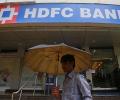
In the quarter gone by (Q3 of FY22), private lender HDFC Bank issued around 950,000 credit cards, its highest ever credit card issuance in any single quarter. Since the Reserve Bank of India (RBI) revoked the embargo on it in August 2021 to issue new credit cards, the lender has issued 1.37 million credit cards. This is according to a senior bank executive, who was present in an analysts' call after the lender's Q3 earnings. In Q3, we achieved the highest ever issuance, with 950,000 card issuances.

The Reserve Bank of India (RBI) is expected to cut interest rates for the first time in nearly five years in Governor Sanjay Malhotra's first monetary policy committee (MPC) meeting on Wednesday. The meeting of the six-member MPC, which will culminate on Friday, aims to boost sluggish economic growth, which is seen falling to a four-year low. Malhotra took charge as the 26th RBI governor in December last year.

The Insurance Regulatory and Development Authority of India's (Irdai's) decision to allow insurers to hedge risks through equity derivatives will help them manage market volatility and protect policyholder returns. However, this move is unlikely to alter their investment strategies.

Given gains in equity prices, it is not surprising that the earnings of asset management companies (AMCs) are growing quicker. The earnings momentum looks set to continue. Good fund performances have thus led to AMC earnings upgrades although valuations are high. Recent market performance and net flow trends have led to earnings upgrades by between 3-8 per cent for FY25-27.

Benchmark Sensex advanced 110 points in a choppy trade on Wednesday, extending its gains to the fourth day in a row helped by buying in HDFC Bank, ICICI Bank and fresh foreign fund inflows. The 30-share barometer rose by 110.58 points or 0.14 per cent to settle at 80,956.33 with 14 of its constituents ending with gains and 16 stocks with losses. During the day, it jumped 399.64 points or 0.49 per cent to 81,245.39 and dipped to a low of 80,630.53.

Markets to track inflation data, global trends, FII trading this week: Analysts New Delhi, Dec 8 (PTI) Investors' sentiments will be guided by a host of domestic and global macroeconomic data announcements this week, along with the trading activity of foreign investors and trends in world stocks, analysts said. Besides, the rupee-dollar trend and movement of global oil benchmark Brent crude will also be crucial in dictating terms in the market, experts added. "The domestic stock market is likely to be shaped by a mix of global cues, domestic economic indicators, and the flow of investments from foreign and domestic institutional investors. Key factors like the rupee's exchange rate and crude oil prices will play a critical role in determining market trends. "Globally, geopolitical tensions, particularly the ongoing Russia-Ukraine conflict, continue to pose challenges. However, recent declines in the dollar index and US bond yields have created a more favourable environment for emerging markets like India," Pravesh Gour, Senior Technical Analyst, Swastika Investmart Ltd, said. On the economic front, significant macroeconomic releases, including retail inflation and industrial production data from India as well as US core CPI, are expected to influence overall market sentiment, Gour added. Last week, the BSE benchmark jumped 1,906.33 points or 2.38 per cent, and the NSE Nifty climbed 546.7 points or 2.26 per cent. "FIIs turning buyers in early December, in a total reversal of their sustained selling strategy during the last two months, has altered the market sentiments. The change in FII (Foreign Institutional Investors) strategy is getting reflected in stock price movements, particularly in large-cap banking stocks in which FIIs have been sellers," VK Vijayakumar, Chief Investment Strategist, Geojit Financial Services, said. The release of US CPI inflation data will give some insights into the Fed's December meeting, an expert said. "The markets' attention is expected to turn towards macroeconomic indicators like IIP and CPI inflation. Additionally, the trend of FII inflows, following their recent buying spree, will remain a key focal point for market participants," Ajit Mishra - SVP, Research, Religare Broking Ltd, said. Siddhartha Khemka, Head - Research, Wealth Management, Motilal Oswal Financial Services Ltd, said this week will see significant economic data releases, including GDP numbers from Japan and the UK, along with China's CPI and India's CPI.

The stock of the country's largest listed oral care company -- Colgate-Palmolive (India) Ltd is up 18 per cent over the past month. The gains were led by better than expected June quarter (Q1) performance of the 2023-24 financial year (FY24) and growth revival expectations of the oral care category. The company's volume growth is pegged at 5-8 per cent in Q1FY24. This is the second consecutive quarter of volume growth.

Credit card spending reached Rs 2 trillion in October, a 14.5 per cent rise from September, largely driven by festival season purchases. However, the volume of outstanding credit cards increased only marginally during the same period. The spike in spending comes at a time when nearly all major credit card issuers are calibrating their growth in the segment due to visible signs of stress.

State-backed Life Insurance Corporation of India (LIC) recorded strong growth in the value of new business (VNB) margin in the third quarter of financial year 2023-24 (Q3FY24) while major listed private life insurers reported a weak performance. VNB refers to the profit that an insurer is likely to garner from new business, which comes from policies sold in a particular period. VNB margin is the profit margin of the insurer.

Investors' wealth tumbled by Rs 9 lakh crore on Friday, in tandem with a sharp decline in the domestic equity market, where the benchmark Sensex plunged 1,414 points following a bearish trend in global equities. Fresh tariff threats that ignited global trade war fears and relentless foreign fund outflows dented investor sentiment, analysts said.

India needs another shot of difficult reform, of the kind only possible at gunpoint. Mr Trump holds that gun to our heads now. A drastic reduction in tariff protection, other elements of sarkari wet-nursing will force entrepreneurial India to become competitive again, argues Shekhar Gupta.

Life insurance companies reported a 13.16 per cent year-on-year (Y-o-Y) growth in new business premium (NBP), totting up Rs 30,347 crore in October, even as the number of policies sold saw a sharp decline. The growth was largely driven by strong performance from private sector life insurers.

In today's rapidly evolving digital payment landscape, security concerns remain a top priority for stakeholders across sectors.

Asset management companies launched 239 new fund offerings (NFOs) mobilising Rs 1.18 lakh crore in 2024, with sectoral or thematic equity funds emerging as the top choice of investors, according to a report by Germinate Investor Services Research. This was higher than 212 NFOs collecting Rs 63,854 crore in 2023 and 228 NFOs garnering Rs 62,187 crore in 2022.

Ask rediffGURU and PF expert Nitin Narkhede your mutual fund and personal finance-related questions.

'Asset allocation should be driven much more by long-term factors rather than the market scenario at any particular point in time.'

Competition in the fast-growing quick commerce sector is heating up as Swiggy Instamart faces a tough challenge in narrowing the gap with Blinkit, which currently dominates the market. In the second quarter (Q2) of 2024-25 (FY25), Instamart's gross order value (GOV) rose by 42.1 per cent quarter-on-quarter (Q-o-Q) and 75.5 per cent year-on-year (Y-o-Y), reaching Rs 3,382 crore.
Ask rediffGURU and PF expert Milind Vadjikar your insurance, stocks, mutual fund and personal finance-related questions.

'We have seen something do very well when the times are good but maybe not as well when the times are bad.'

From the 30-share pack, Adani Port, Bharti Airtel, Asian Paints, IndusInd Bank, Bajaj Finserv, Reliance Industries, Infosys, UltraTech Cement, HDFC Bank, HCL Technologies and ICICI Bank were among the laggards. Tata Motors, Axis Bank, Maruti, Larsen & Toubro, ITC and Tata Steel were among the gainers.

From the 30 Sensex pack, ICICI Bank climbed 3 per cent after the private sector lender posted a 14.5 per cent growth in standalone profit to Rs 11,746 crore for the second quarter ended September 2024. JSW Steel, Mahindra & Mahindra, Adani Ports, Tata Steel, Sun Pharma, Hindustan Unilever, Tata Motors and State Bank of India were the other big gainers from the pack.

With slippages increasing every quarter, any derailment on growth or change in customers' repayment behaviour after moratorium may impact the overall asset quality. Correction, though, presents attractive buying opportunities, given the bank's sustained leadership position.

The July-September quarter results of software companies in the engineering research and development (ER&D) segment were broadly in line with expectations, though there have been cuts in revenue growth guidance. While results were a mixed bag, and there are cautionary views on the near-term outlook, brokerages and global consulting firms highlight the strong growth trajectory for the sector. They expect this segment of the software sector to grow by 8-12 per cent going forward.

If growth reverts to the pre-Covid level, a lot of people may have to temper their rosy optimism, points out Debashis Basu.

Bajaj Finance was the top gainer in the Sensex pack, surging around 5 per cent, followed by Bajaj Finserv, HDFC, Tech Mahindra, HDFC Bank, UltraTech Cement and Tata Steel. On the other hand, HUL, Nestle India, ICICI Bank, Axis Bank, SBI, TCS and ITC were among the laggards.

These 10 stocks represent the best mix of value and growth, offering relatively low price-to-earnings and price-to-book ratios, a high return on equity, and sufficiently high potential from current levels.

The last time this happened was in 1996.
